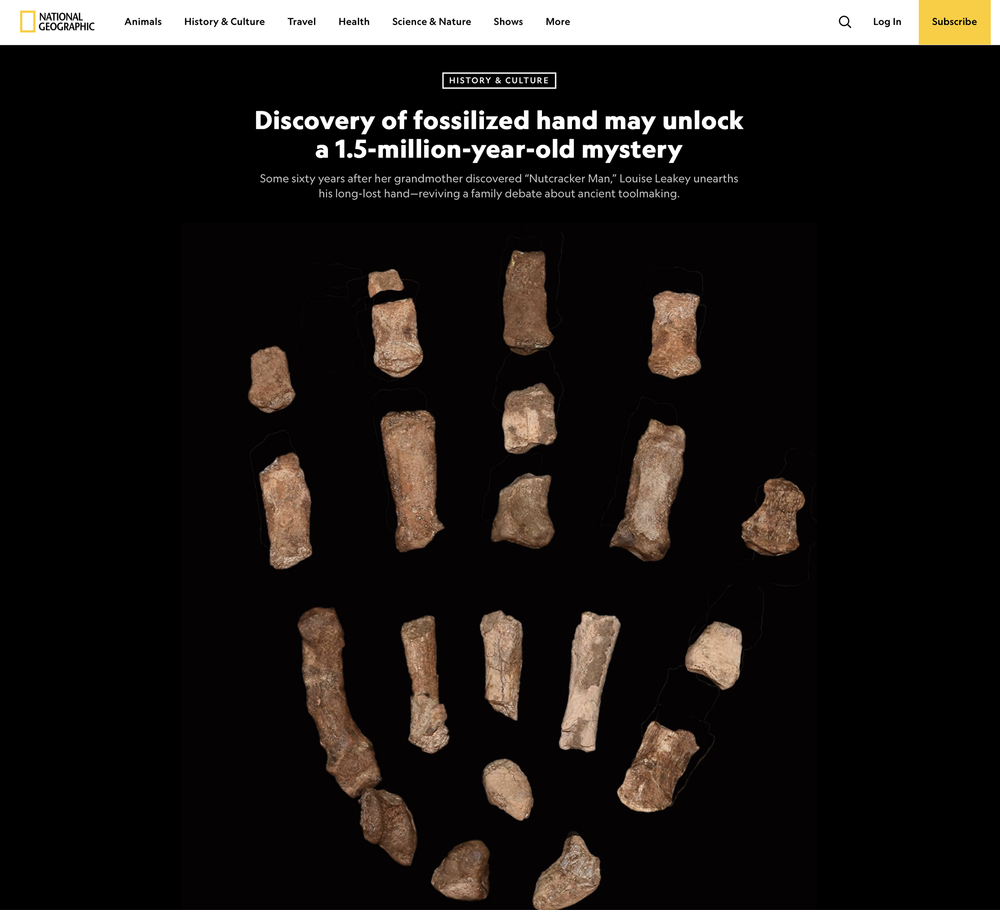
New fossils reveal the hand of Paranthropus boisei
KNM-ER 101000 preserves the first hand and foot bones unambiguously associated with the skull and teeth of P. boisei, from ~1.52-million-year-old deposits at Koobi Fora, Kenya.
Publications
Click any title to open the article.
-
The frontal sinus of the adult human cranium from Border Cave, KwaZulu-Natal, South Africa: Does it provide a contextual clue?
The Anatomical Record
-
New partial skeleton of Homo habilis from the upper Burgi Member, Koobi Fora Formation, Ileret, Kenya
The Anatomical Record, 309(3), 485–545
-
The hierarchical nature of mammalian tooth enamel resilience, and a novel measure of decussational strength in human molars
The Anatomical Record
-
The phylogenetic relationships of robust australopiths
In P. J. Constantino, K. E. Reed, & B. A. Wood (Eds.), The Forgotten Lineage(s) (pp. 461–473). Vertebrate Paleobiology and Paleoanthropology. Springer.
-
Comparability of CT and μCT-extracted femoral diaphyseal data in primates
American Journal of Biological Anthropology, 190(1), e70268
-
New fossils reveal the hand of Paranthropus boisei
Nature, 647, 944–951
-
A Late Pleistocene human pedal phalanx from the Pinnacle Point PP5-6N rock-shelter, Western Cape Province, South Africa
American Journal of Biological Anthropology, 187(3), e70086
-
Variation, sexual dimorphism, and enlargement of the frontal sinus with age in adult South Africans
American Journal of Biological Anthropology, 183(4), e24899
-
Frontal sinus size in South African Later Stone Age Holocene Khoe-San
The Anatomical Record, 308(3), 801–826
-
Nondestructive geochemical characterization of fossil hominin taphonomy and burial history
Quaternary Science Reviews, 328, 108525
-
Metopism in adult South Africans and its relationship to frontal sinus size
The Anatomical Record, 307(6), 2018–2035
-
Hypercementosis in Late Pleistocene Homo sapiens fossils from Klasies River Main Site, South Africa
Archives of Oral Biology, 149, 105664
-
Pleistocene hominin fossil record of Africa
In Handbook of Pleistocene Archaeology of Africa (pp. 1807–1820). Springer.
-
Rules of teeth development align microevolution with macroevolution in extant and extinct primates
Nature Ecology & Evolution, 7, 1729–1739
-
An updated analysis of hominin phylogeny with an emphasis on re-evaluating the phylogenetic relationships of Australopithecus sediba
Journal of Human Evolution, 175, 103311
-
Implications of outgroup selection in the phylogenetic inference of hominoids and fossil hominins
Journal of Human Evolution, 184, 103437
-
Taxonomic status of the KNM-ER 1500 partial skeleton from the Burgi Member of the Koobi Fora Formation, Kenya
Journal of Human Evolution, 184, 103426
-
The taxonomic attribution of African hominin postcrania from the Miocene through the Pleistocene: Associations and assumptions
Journal of Human Evolution, 173, 103255
-
Developmental processes mediate alignment of the micro- and macroevolution of primate molars
Evolution, 76, 2975–2985
-
Modeling hominin evolution requires accurate hominin data
Nature Ecology & Evolution, 6, 1090–1091
-
The effect of data provenance on estimates of gestation length in African and Asian colobines
American Journal of Physical Anthropology, 176(4), 606–613
-
Drimolen cranium DNH 155 documents microevolution in an early hominin species
Nature Ecology & Evolution, 5(1), 38–45
-
The evolution of mammalian brain size
Science Advances, 7(18), eabe2101
-
Secular trends in cranial size and shape among Black South Africans over the late 19th and 20th centuries
Annals of Human Biology, 1–28
-
Human manual distal phalanges from the Middle Stone Age deposits of Klasies River Main Site, Western Cape Province, South Africa
Journal of Human Evolution, 146, 102849
-
Tempo and pattern of avian brain size evolution
Current Biology, 30(11), 2026–2036
-
Costly teeth? Gestation length in primates suggests that neonate dentition is not expensive to produce
The Anatomical Record, 303(9), 2476–2484
-
Complete permanent mandibular dentition of early Homo from the upper Burgi Member of the Koobi Fora Formation, Ileret, Kenya
Journal of Human Evolution, 131, 152–175
-
Expanded character sampling underscores phylogenetic stability of Ardipithecus ramidus as a basal hominin
Journal of Human Evolution, 131, 28–39
-
Allometry, evolution and development of neocortex size in mammals
Progress in Brain Research, 250, 83–107
-
Evolution and function of the hominin forefoot
Proceedings of the National Academy of Sciences, 115(35), 8746–8751
-
The nasal complex of a semiaquatic artiodactyl, the moose (Alces alces): Is it a good evolutionary model for the ancestors of cetaceans?
The Anatomical Record, 302(5), 667–692
-
Further human fossils from the Middle Stone Age deposits of Die Kelders Cave 1, Western Cape Province, South Africa
Journal of Human Evolution, 109, 70–78
-
On the accuracy and theoretical underpinnings of the multiple variance Brownian motion approach for estimating variable rates and inferring ancestral states
Biological Journal of the Linnean Society, 121(1), 229–238
-
A multiple variance Brownian motion framework for estimating variable rates and inferring ancestral states
Biological Journal of the Linnean Society, 118(1), 78–94
-
Cross-sectional structural variation relative to midshaft along hominine diaphyses. I. The forelimb
American Journal of Physical Anthropology, 158(3), 386–397
-
Cross-sectional structural variation relative to midshaft along hominine diaphyses. II. The hind limb
American Journal of Physical Anthropology, 158(3), 398–407
-
Exercise-induced bone formation is poorly linked to local strain magnitude in the sheep tibia
PLOS ONE, 9(6), e99108
-
Age-related variation in limb bone diaphyseal structure among Inuit foragers from Point Hope, northern Alaska
Archives of Osteoporosis, 9(1), 202